Balance Sheet Format

| The balance sheet format summarizes the balance sheet accounts into assets, liabilities and owners’ equity. |
The balance sheet format helps the user by grouping these accounts into classes such as the function of the account, the business use of the resources, and whether resources and liabilities are short-term or long-term. This balance sheet format is called the classified balance sheet.
Balance Sheet Accounts: Assets
The balance sheet lists assets in descending order of liquidity, with the most liquid assets listed first.
For example, Sunny Sunglasses Shop lists the current assets in order of liquidity, or how quickly the asset can be converted to cash.
Assets listed in descending order of liquidity
|
Cash is the most liquid of assets, but also may include treasury bills, money market funds, short-term loans, and certificates of deposit (CD’s).
Accounts receivable are what customers owe the company for products or services delivered on credit. Accounts receivable are less liquid than cash, but are expected to be collected within 30 to 60 days per payment terms.
Inventory is product for sale and is the next liquid asset because it is expected to be sold and converted to cash within one year.
Finally, prepaid expenses are those expenses that are already paid for future services not yet received. Typical prepaid expenses are prepaid insurance and prepaid rent. Prepaid expenses are assets because they represent cash payments already made for services not yet received.
Following the current assets are the non-current assets.
Non-current assets are also listed in order of liquidity. For example, companies list investments that are intended to be held for longer than one year as a non-current asset in the balance sheet accounts. Long-term investments include stocks, bonds, mutual funds, and long-term notes receivable.
Following investments are fixed assets, also called property plant and equipment (PP&E).
Fixed assets include office equipment, furniture, vehicles, machinery, buildings, and even land. Fixed assets are productive assets that are not intended for sale, but are employed to support the production or the sale of product or services.
Following fixed assets are nontangible assets such as patents, copyrights, logos, and other legal rights that are expected to provide long-term future benefits to the company. Nontangible assets also include goodwill, or the amount paid for a company over its net book value.
Balance Sheet Accounts: Liabilities
The balance sheet format similarly lists liabilities as current liabilities, those liabilities or obligations that will come due within one year of the balance sheet date, and long-term liabilities that will remain outstanding for longer than one year. The short-term portion of the long-term liability, however, is listed as a current liability on the classified balance sheet format.
For example, Sunny’s mortgage on the land is considered a long-term liability, but the $900 due within one year is listed as a current obligation on the classified balance sheet format.
The Classified Balance Sheet Format
| ASSETS | LIABILITIES AND OWNERS’ EQUITY |
| Current Assets (Cash, A/R, Inventory) | Current Liabilities (Accounts Payable, Current debt) |
| Noncurrent Assets | Long-Term Liabilities |
| Investments | Owners Equity |
| Fixed Assets (PP&E) | Contributed capital |
| Intangible assets | Retained earnings |
The balance sheet format allows the financial statement user to quickly see which assets are short or long-term assets, and what the assets are comprised of in the business.
The Balance Sheet Format: Assets
Assets are divided into two broad categories on the accounting balance sheet: current assets and noncurrent assets.
In the above example, cash is a current asset, and land is a noncurrent asset.
|
The balance sheet format also allows the user to quickly see which liabilities are short or long-term liabilities, and what the liabilities are comprised of in the business.
The Balance Sheet Format: Liabilities
Like assets, liabilities are divided into two broad categories on the accounting balance sheet: current liabilities and noncurrent liabilities.
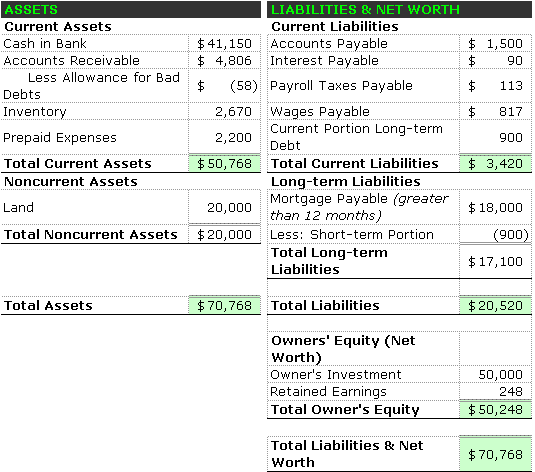
In the below classified balance sheet for Sunny Sunglasses Shop, a portion of the mortgage, $900, is a short-term liability because it is due within one year. The remaining balance of $17,100 is not payable within one year and is classified as a long-term liability. |
Sunny Sunglasses Shop
Balance Sheet Format
January 31, 2020
Back from Balance Sheet Format to the Accounting Balance Sheet Main Page
Online Accounting|Business Accounting Home Page

Both GAAP and IFRS prefer the classified balance sheet format similar to the above.
I need Format Of financial Statement Prescribed By ifrs
Thanks for the nice web site – it is really helpful.
Hi Thomas and others –
The Indian Companies Act of 1956 schedule VI Part 1 requires companies to show assets and liabilties in a particular balance sheet format, but this website is based on US GAAP which may or may not fulfill that requirement.
Kenneth
i need a balance sheet format of schedule VI part 1
He i need a websites where i can found every thing related to accounts & balancesheet.
Thanks,
laxmi Narayan
I am very glad to have it. I have refresh my memory.
plz give me balance sheet format
I NEED SCHEDULE VI FORMAT BALANCE SHEET.
Pls can i show a balance sheet and a financial report for u to check…It just a small one
Yes, prepaid rent is an asset that shows up on the balance sheet. When rent is consumed it becomes a rent expense on the income statement, but only after prepaid rent is used up.
I’m certainly glad it helped you and thank you for your feedback.
I am an Accounting graduate and this is just a perfect summary of wot i have learnt @ diffferent stages while in school.now i have a better understanding of some items under d headings of a balance sheet and this may help me perform excellently if am being interviewed on Final Accounts.
Thanks a bunch
prepaid rent condsider in balanace sheet or not
where can i see the updated pages?
company take the loan 50000 by cash how to treat this entry
Hello Ramandeep –
The balance sheet only shows permanent accounts. Income and expense items are temporary accounts shown on the income statement and then closed to retained earnings during the closing entry process. Click closing entries for more info.
Kenneth
where would one place their expenses and revenue? i know that usually you would only place them in your income statement but could you also place them in the classified balance sheet?
Hi Zainuddin –
Net earnings increase retained earnings and owners equity, and owner withdrawls decrease retained earnings and owners equity. So the owners equity account increased $200 from net profit last year, and decreased by $100 this year from withdrawls. This leaves a net increase of $100, not accounting for any net profits (or losses) this year.
For a look at what increases and decreases retained earnings, please see retained earnings.
Kenneth
i require 2 years combine comprehensive balance sheet in which last year net profit i.e 200 & now this year owner withdrawl profit of 100 from last year net profit how can this effect shown on this year balance sheet
I am a preliminary learner of this subject. I found it easily understandable. Thanks the site for its affords.
Thank you – I am very glad to hear it! I hope you pass your test with flying colors!
perfecttt! best examples given online! It was the most helpful thing. Im a grade eleven student taking introduction to accounting, and this may just have helped me pass my test tomorrow! thankssss.